For decades, watching television in Canada followed a fairly predictable formula. You signed up with a cable or satellite provider, rented a box, and paid for large channel bundles that often included far more content than you actually watched. It wasn’t always cheap, but for a long time, it was simply how television worked.
Then streaming changed everything.
When Netflix exploded in popularity in the late 2000s and early 2010s, it fundamentally changed consumer expectations around entertainment. Suddenly, people could watch what they wanted, when they wanted, without schedules, contracts, or expensive cable hardware. Entire seasons could be binge-watched in a weekend. Content could be streamed on phones, tablets, laptops, smart TVs, and gaming consoles. For many households, it felt like television had finally entered the Internet era.
More importantly, consumers realized something bigger: TV no longer needed to be delivered through traditional cable infrastructure. The Internet itself could become the platform.
That realization sparked the beginning of what became known as cord cutting.
📺 How We Got Here
Traditional Cable Became Expensive
Large bundles • Contracts • Paying for channels nobody watched
⬇️
Netflix Changed Consumer Expectations
On-demand movies and shows • Watch anywhere • Lower monthly costs • No traditional cable box required
⬇️
Every Media Company Wanted Its Own Platform
Disney+ • Prime Video • Crave • Sportsnet+ • TSN+ • DAZN • Apple TV+
⬇️
Streaming Became Fragmented Again
Multiple subscriptions • Multiple apps • Rising monthly costs • Sports spread across platforms
⬇️
Consumers Started Looking for Simpler Alternatives
IPTV • Android boxes • Firesticks • Consolidated streaming setups
⬇️
What Most People Actually Want
Affordable entertainment that’s simple, stable, and easy to access
The Streaming Revolution Started Simply
In the early streaming era, the value proposition felt almost too good to be true.
Netflix offered a massive on-demand library at a relatively low monthly cost. Compared to traditional cable bills, it felt flexible, modern, and refreshingly simple. For many Canadians, it was the first time entertainment felt truly consumer-friendly.
Naturally, other companies noticed.
As streaming grew, nearly every major media company launched its own platform. Disney introduced Disney+, HBO content became more exclusive, sports leagues created standalone subscriptions, and broadcasters increasingly pulled content back behind their own streaming walls.
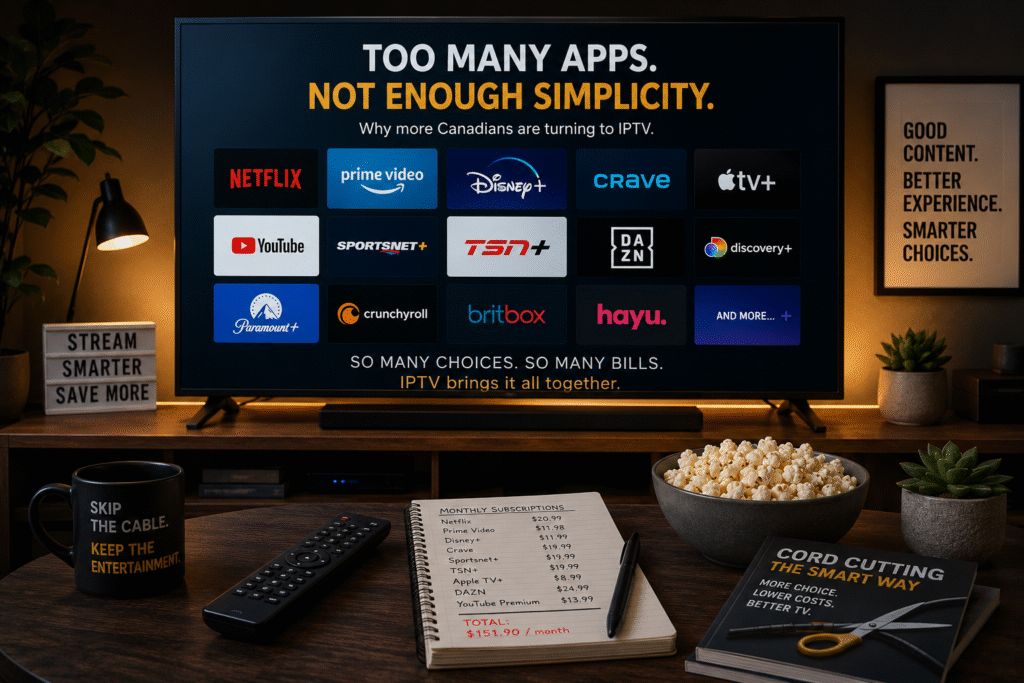
What began as a simpler alternative to cable slowly evolved into a fragmented ecosystem of competing services:
- Netflix
- Prime Video
- Disney+
- Crave
- Sportsnet+
- TSN+
- DAZN
- Apple TV+
- Paramount+
- and many others
Instead of one cable bill, households suddenly found themselves managing multiple subscriptions, multiple apps, multiple logins, and multiple monthly charges.
Netflix + Disney+ + Prime Video + Sportsnet+ + TSN + Crave + DAZN
For many households, streaming slowly became just as fragmented, and sometimes nearly as expensive, as traditional cable.
And in many ways, consumers began feeling something familiar all over again:
they were paying more while feeling like they were getting less.
The Real Frustration Wasn’t Just Cost
Rising prices absolutely played a role in consumer frustration, but cost alone doesn’t fully explain why IPTV became so popular.
The deeper issue was fragmentation.
Streaming was originally supposed to simplify entertainment. Instead, many households found themselves constantly searching for where content actually lived. A movie you wanted to watch might not be available on any of your existing subscriptions. One service carried hockey, another carried UFC, another had a popular TV series everyone was talking about, while another locked away older movies behind a rental fee.
Recommendation engines often didn’t help much either. Instead of making discovery easier, many users felt overwhelmed by fragmented libraries, rotating catalogs, and endless content suggestions that didn’t match what they were actually looking for.
For many consumers, the frustration became:
“Why is it suddenly so hard and expensive to simply watch the content I want?”
That environment created the perfect conditions for IPTV to explode in popularity.
Many consumers felt modern streaming had become fragmented and inconvenient. Instead of simplifying entertainment, households suddenly needed multiple subscriptions, multiple apps, and multiple logins just to access the movies, sports, and shows they wanted to watch.
What IPTV Actually Is
IPTV stands for Internet Protocol Television. Simply put, it means television delivered over Internet networks instead of through traditional cable or satellite systems.
In many ways, IPTV is similar to how VoIP delivers phone calls over the Internet instead of through traditional phone lines. The technology itself isn’t illegal, underground, or even particularly new. In fact, many mainstream TV providers already rely heavily on IPTV infrastructure behind the scenes, even if they market their services under names like Fibe TV, Ignite TV, or Optik TV instead of explicitly calling them “IPTV.”
IPTV usually refers to live television delivered over Internet networks, while services like Netflix or Prime Video are typically classified as OTT (Over-The-Top) streaming platforms focused primarily on on-demand movies and shows.
What changed over the last several years was how consumers began interacting with the term online.
As subscription fatigue grew, many people started searching for alternatives that promised:
- more flexibility
- simpler access to content
- fewer subscriptions
- live sports
- international channels
- streaming across multiple devices
That’s one reason why Android boxes, Firesticks, streaming apps, and IPTV-related services became so heavily discussed online. For Canadians looking for a more affordable alternative to traditional cable packages, we also compared some of the best IPTV alternatives to Bell Fibe available today.
For many users, the appeal wasn’t necessarily about “piracy.” It was about convenience. People wanted something that felt less fragmented than the modern streaming landscape had become.
f you’re still unclear about the difference between licensed and gray-market services, our guide on Is IPTV Legal in Canada? explains how IPTV works and why some services operate very differently from others.
Why “All-in-One” Streaming Became So Appealing
One of the biggest psychological shifts in entertainment over the last decade is that consumers became accustomed to near-universal access.
Early Netflix conditioned viewers to expect large libraries, instant streaming, and simple discovery. But as content became increasingly divided across competing services, consumers started feeling like entertainment was becoming complicated again.
That’s why services advertising “everything in one place” became so attractive to many users.
People weren’t necessarily looking for thousands of channels specifically. They were looking for simplicity:
- one platform
- one search
- one app
- one bill
- easier access to sports, movies, and live TV
Whether those expectations were realistic or sustainable is a separate conversation. But emotionally, the appeal made sense.
Consumers were trying to solve a problem the entertainment industry itself had gradually created.
The Line Between Streaming and Traditional TV Is Already Blurry
One reason IPTV confuses so many people is because the entire television industry is already moving toward Internet-delivered entertainment.
Traditional cable providers increasingly rely on streaming infrastructure. Streaming platforms experiment with live sports and live TV. Smart TVs now function more like app platforms than traditional televisions. Many younger households have never even used a conventional cable box.
At this point, the line between “streaming TV” and “traditional TV” is already far blurrier than many consumers realize.
The real differences today often come down to:
- licensing
- reliability
- support
- streaming quality
- infrastructure
- user experience
Not simply whether something is “IPTV.”
Convenience Still Matters More Than Endless Content
For some households, IPTV-style setups work perfectly fine. For others, frustrations eventually begin appearing over time:
- buffering during major sports events
- apps suddenly changing
- disappearing channels
- unstable streams
- inconsistent quality
- unreliable support
- constant troubleshooting
That doesn’t mean every IPTV service is problematic. But it does highlight something important: most people ultimately care more about convenience and reliability than endless channel counts.
At the end of the day, most households simply want:
- affordable entertainment
- live sports that work consistently
- easy setup
- fewer headaches
- stable streaming
- straightforward pricing
That’s often the real destination consumers are searching for, even if they initially enter the IPTV world through curiosity about “cheap TV.”
Modern streaming setups rely heavily on Internet stability, Wi-Fi coverage, router quality, and the number of connected devices in the home. In many households, buffering and streaming issues are actually caused by weak Wi-Fi or overloaded home networks rather than the streaming platform itself.
If you’re unsure how much speed your household actually needs for streaming, gaming, video calls, and live TV, our Internet Speed Calculator can help estimate the right fit for your home.
You can also compare Internet plans available in your area to see whether you may be overpaying for your current setup.
Where NetJOI TV Fits Into the Picture
At NetJOI, our focus is Internet and Digital Home Phone.
When it comes to entertainment, we understand why IPTV and streaming became so popular in the first place. Canadians wanted more flexibility, simpler choices and the ability to watch what they wanted across modern devices.
Today, that flexibility doesn’t necessarily require choosing a traditional TV package.
With a reliable Internet connection, households can build their own entertainment lineup using legitimate standalone services such as Netflix, Crave, Disney+, Prime Video, CBC Gem and other streaming options that work independently of their Internet provider.
That means you can choose your Internet provider based on the Internet service itself, then add or remove entertainment services as your viewing habits change.
For households that still prefer a traditional live-TV experience, established IPTV providers remain an option. But for Canadians who value flexibility, keeping Internet and entertainment separate can provide more freedom over time.
Learn more about NetJOI Internet and choosing the right Internet speed for streaming.
Final Thoughts
IPTV didn’t become popular because consumers suddenly stopped wanting legitimate entertainment.
It became popular because the modern streaming landscape became increasingly fragmented, expensive, and complicated.
Traditional cable frustrated consumers for years. Streaming initially promised something simpler. But as entertainment splintered across countless subscriptions and apps, many households once again found themselves searching for a more flexible and affordable solution.
IPTV became part of that evolution because it represented another attempt to simplify how people access television in the Internet era.
And as the industry continues evolving, one thing remains clear: most consumers aren’t looking for complicated setups or endless subscriptions.
They simply want entertainment that feels easy again.