
Intro
When it comes to setting up VoIP at home, the first piece of hardware most people run into is the ATA (Analog Telephone Adapter). There are plenty of models out there from older Linksys and Cisco units, Obihai devices, even routers with built-in VoIP ports.
But if you’re looking for something that’s reliable, compact, and supported in Canada today, the Grandstream HT801 and HT802 stand out as smart choices.
- The HT801 gives you a single phone port – perfect for one line.
- The HT802 adds a second port, which is handy if you want two phones, or a phone plus a fax machine.
At NetJOI, we recommend these adapters because they strike the right balance of affordability, rock-solid performance, and easy setup. They don’t come with extras like built-in Wi-Fi or fancy displays, but that’s not really a drawback. They’re purpose-built to keep your phone service clear and dependable over VoIP.
👉 Want a broader look at all the gear VoIP can use? See our VoIP Equipment Guide.
HT801 vs HT802 at a Glance
| Feature | Grandstream HT801 | Grandstream HT802 |
|---|---|---|
| Ports | 1 FXS port | 2 FXS ports |
| Use Case | Single phone line | Two phones or phone + fax |
| Size | Compact, desktop | Still compact, slightly wider |
| Power | Low power (adapter included) | Low power (adapter included) |
- Choose the HT801 if you only need one phone line.
- Choose the HT802 if you want the flexibility of two lines, or you’re planning to connect a fax machine.
Key Features
- Excellent call quality with SIP support.
- LED indicators for quick status checks.
- Small footprint that fits easily on a desk or shelf.
- Proven reliability — designed for continuous operation.
Why the HT801 and HT802 Lead the Pack
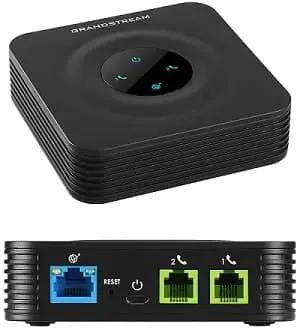
The HT801 and HT802 are two of the most widely used VoIP adapters in Canada and around the world. Here’s why:
- Actively supported – Unlike many older ATAs, these models still receive regular firmware updates from Grandstream.
- Provider-approved – Countless VoIP providers (including NetJOI) recommend or ship these devices because they’re reliable and easy to standardize.
- Proven track record – Millions of households and small businesses use the HT801/802 for clear, stable VoIP calling.
- Affordable and available – At a fraction of the cost of other VoIP hardware, they’re easy to source and replace.
For most people, the HT801/802 are the sweet spot: modern, dependable, and supported long-term.
Manufacturer & Longevity
The HT801 and HT802 aren’t just popular – they come from Grandstream Networks, a company that’s been building communication solutions since 2002. Headquartered in Boston with offices worldwide and over 500 employees, Grandstream products are used in more than 150 countries.
These adapters have been trusted for years by households and businesses, and the product line continues to evolve with refreshed v2 models and regular firmware updates. That means you’re not buying a short-lived gadget, you’re choosing a device with proven reliability and active support.
Key Technical Highlights (Plain English)
The HT801 and HT802 may look simple, but under the hood they support the same standards as much bigger VoIP systems. Here are the key bits of tech — explained without the jargon:
- SIP-compatible – SIP (Session Initiation Protocol) is the “language” most VoIP services use to set up calls. Since the HT801/HT802 are SIP-compatible, they’ll work with almost any provider.
- Audio Codecs (G.711, G.729) – Think of codecs like the “file format” for your voice. G.711 = uncompressed, crystal-clear calls (needs a bit more bandwidth). G.729 = compressed calls that save bandwidth but still sound good. The device supports both.
- T.38 Fax Support (HT802 only) – The HT802 can handle faxing over the internet using a special mode called T.38. It makes fax more reliable on VoIP, though results may still vary depending on your setup.
- NAT Traversal / SIP Keep-Alive – Your adapter automatically “pokes” your router to keep the phone line open, so calls don’t drop or fail if your internet connection gets quiet.
- Web Interface Access – You can log into the device with a web browser by typing its local IP address (like 192.168.0.1). This is where advanced settings live, but if you buy from NetJOI, you don’t need to touch this, we ship them pre-configured.
- Always-On Design – These adapters sip power (just a few watts) and are meant to run 24/7, like your modem or router.
Setup Guide (High Level)
Getting started with the HT801 or HT802 is simple:
- Connect to your router using the included Ethernet cable.
- Plug in your phone to the “Phone” port on the adapter.
- Power it on with the included adapter.
- Wait for the LEDs to stabilize (Power, WAN, and Phone).
If you buy your ATA from NetJOI, that’s it! Your adapter is pre-configured and ready to go out of the box. Just plug it in and start making calls.
If you buy from a third-party source, you’ll need to log into the device’s web interface (192.168.0.1) and manually configure SIP settings from your provider.
Troubleshooting Basics
- No dial tone? Check cabling, restart the adapter, and make sure your router is online.
- LED not lit? Power cycle and verify the adapter is plugged into a working outlet.
- Can’t log in? Default access is usually at 192.168.0.1; consult the manual for default credentials.
For NetJOI customers, our support team can help if issues persist.
Alternative Devices (NetJOI-Supported)
At NetJOI, the Grandstream HT801 and HT802 are our official, recommended adapters. We’ve chosen them because they’re dependable, affordable, and easy for customers to use.
We also support the Cisco SPA122, a solid alternative if you’re already familiar with Cisco gear.
Buying your adapter directly from NetJOI means it arrives pre-configured, so you avoid the hassle of manual setup.
FAQs
Can I use my existing phone?
Yes. That’s the purpose of an ATA – it lets you keep using your regular analog phone with VoIP service.
Can I keep my number?
Yes. NetJOI supports number porting, so you don’t lose your old number.
Does NetJOI support fax?
The HT802 includes support for the T.38 fax protocol, which is designed to make faxing more reliable over VoIP. That said, fax over VoIP is not guaranteed, and NetJOI officially supports voice services only.
What if I buy my adapter from Amazon?
It will work, but you’ll need to configure it yourself. ATAs purchased from NetJOI come pre-configured, so setup is truly plug-and-play.
Conclusion
The Grandstream HT801 and HT802 are compact, reliable ATAs that make switching to VoIP simple. Whether you need one line or two, these devices deliver clear calls without the complexity.
For NetJOI customers, the process couldn’t be easier: order your VoIP plan with an adapter, plug it in, and start calling.
👉 Want to learn more about VoIP in Canada? Explore our full set of Phone Guides for comparisons, provider reviews, and how-tos.
👉 Ready to switch? Check VoIP availability and order today.