
Many Canadian households are paying far more for telecom services than they realize.
Not necessarily because they intentionally chose expensive plans, but because costs quietly grow over time through promotional pricing, equipment rentals, bundled services, streaming subscriptions, and older plans that were never revisited.
For some households, it’s an extra $20–$40/month. For others, it can be much more.
The good news is that reducing telecom costs doesn’t always require drastic changes. In many cases, a few practical adjustments can make a meaningful difference over time — without sacrificing the services you actually use.
In this guide, we’ll look at several practical ways Canadians are lowering their Internet, TV, and home phone costs in 2026.
Many households continue paying promotional pricing long after it stops being competitive. Reviewing your telecom services once per year can uncover surprisingly large savings over time.
Curious how much your current Internet setup may actually cost over time once promotional pricing expires?
Try our Internet Savings Calculator.
1. Stop Paying for More Speed Than You Actually Need
One of the easiest ways Canadians overspend on Internet is by paying for speeds they rarely use.
Gigabit Internet sounds impressive, but many households simply don’t need it. For everyday usage like Netflix, YouTube, Zoom calls, social media, and online gaming, plans in the 100–250 Mbps range are often more than enough.
That doesn’t mean Gigabit has no place – large households, heavy downloaders, and power users may absolutely benefit from it. But many providers automatically push customers toward higher-priced tiers without explaining what most families realistically need.
If you’re unsure, it’s worth reviewing:
- how many people use your connection
- how many devices are active simultaneously
- whether buffering issues are actually Wi-Fi related instead of speed-related
You can also explore how much Internet speed most households actually need before paying for a more expensive plan.
2. Watch for Promo Pricing Expiration
This is one of the biggest reasons telecom bills slowly increase over time.
Many providers advertise attractive introductory pricing for:
- 12 months
- 24 months
- “Value Plans”
- bundle promotions
But once the promotional period ends, monthly costs often increase quietly.
A plan that started at $60/month can eventually become $90–$110/month after:
- discounts expire
- autopay conditions change
- contracts end
- bundled credits disappear
Some households don’t notice these increases immediately because they happen gradually over time.
Some providers advertise pricing that only applies when customers:
- agree to a multi-year contract
- enable autopay
- bundle additional services
- accept temporary promotional pricing
If you want a deeper breakdown of how promotional pricing affects long-term telecom costs, you can also read:
3. Review Equipment Rental Fees
Equipment fees are easy to overlook because they’re often buried inside monthly bills.
Many households continue paying:
- modem rental fees
- router rental fees
- Wi-Fi extender fees
- older hardware fees
…for years.
In some cases, customers end up paying far more in rental costs than the equipment itself would cost to own.
That’s one reason many Canadians now:
- bring their own modem
- purchase equipment outright
- review whether monthly rental charges are still necessary
If you already own a compatible DOCSIS 3.1 modem, some providers may allow you to avoid monthly rental fees entirely.
You can also learn more about keeping your own modem and avoiding unnecessary equipment rental fees.
4. Re-Evaluate Streaming & TV Subscriptions
A few years ago, many households cut cable to save money.
Ironically, some are now paying for:
- Netflix
- Disney+
- Prime Video
- sports subscriptions
- specialty streaming apps
- IPTV services
- leftover cable packages
…all at the same time.
Subscription costs can quietly stack up.
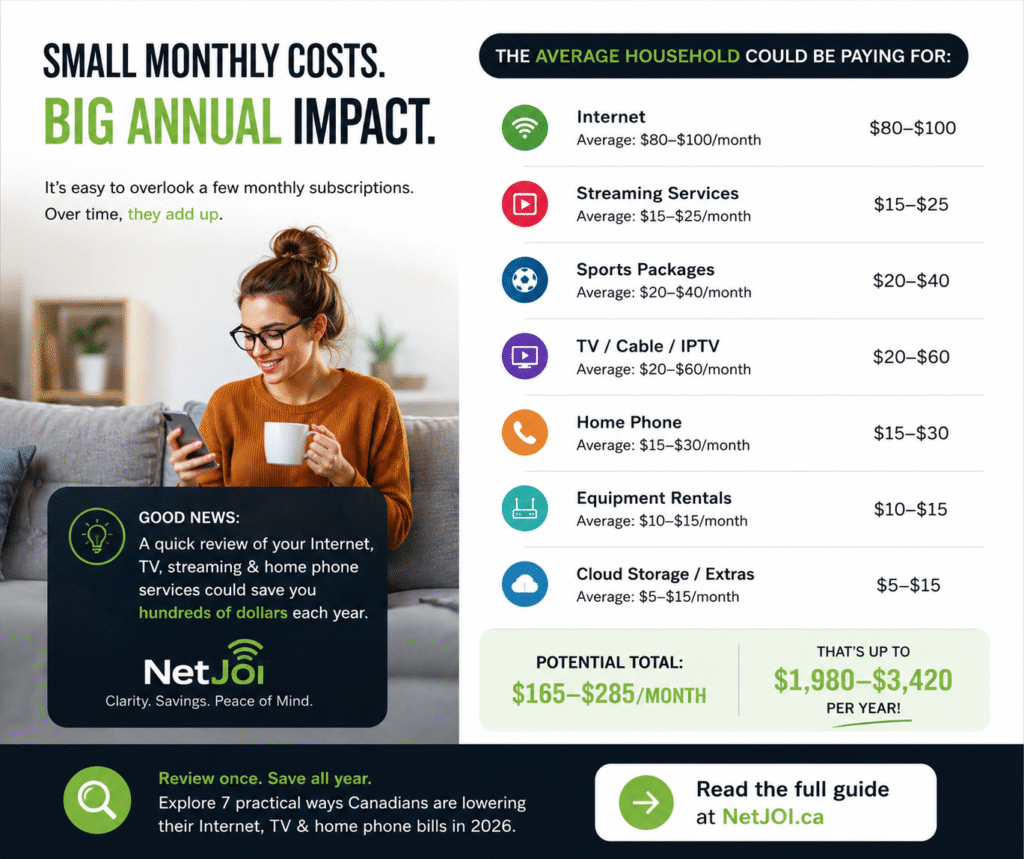
Many households now pay for several streaming services simultaneously without regularly reviewing what they actually watch.
This is also one reason IPTV and alternative TV platforms became increasingly popular in Canada over the past few years.
You can read more about:
- why IPTV became so popular in Canada
- simpler TV alternatives designed for modern streaming households
5. Don’t Ignore Home Phone Costs
Many households still pay surprisingly high monthly fees for traditional home phone service, especially when bundled with older telecom packages.
For some families, home phone service still matters:
- emergency backup
- older family members
- business use
- reliability preferences
But that doesn’t necessarily mean paying legacy pricing forever.
Some households have reduced costs by:
- switching away from traditional landline pricing
- simplifying bundled services
- reviewing whether unused features are still necessary
The important thing for most people is:
- keeping their number
- maintaining reliability
- keeping setup simple
Not whether the underlying technology is called “VoIP.”
Some households are now replacing expensive legacy home phone plans with simpler digital home phone alternatives that still let them keep their existing number.
6. Compare Providers in Your Province
Internet pricing and availability vary dramatically across Canada.
A plan that looks competitive in one province may be:
- unavailable elsewhere
- priced differently
- tied to different promotional structures
That’s why more Canadians are comparing providers regionally instead of relying only on national advertising.
If you’re reviewing long-term telecom costs, it’s often worth comparing:
- promotional pricing
- contract requirements
- equipment fees
- autopay conditions
- long-term pricing stability
You can explore:
- Internet providers and pricing structures in Alberta
- Unlimited Internet providers in BC
- Internet providers in Nova Scotia
- Affordable Internet providers in Ontario
7. Revisit Your Telecom Setup Once Per Year
Most households don’t intentionally overspend on telecom services.
Instead, costs usually drift upward gradually over time through:
- expired promotions
- extra subscriptions
- equipment rentals
- older bundled services
- unused features
Reviewing your setup once per year can help identify:
- unnecessary costs
- overlapping subscriptions
- outdated plans
- opportunities to simplify
Even relatively small changes can add up meaningfully over time.
Saving even $20-$40/month across Internet, TV, and home phone services can add up to hundreds of dollars per year over time.
Final Thoughts
Reducing telecom costs isn’t always about finding the absolute cheapest provider.
In many cases, the biggest savings come from:
- understanding what you actually use
- avoiding unnecessary fees
- reviewing older plans
- simplifying overlapping services
- choosing providers with straightforward pricing
As Internet, TV, and home phone services continue evolving in Canada, more households are looking for:
- transparency
- predictability
- simplicity
- fewer billing surprises
And for many Canadians, that starts simply by taking a closer look at what they’re already paying for.